Tuesday, June 3, 2014

Notice and Note Post # 1

I am linking up with some great bloggers to read the book Notice and Note. (And, trying to do it from the beach in California on the iPad instead of at home in Arizona- so pardon any mistakes I make)

http://www.dilly-dabbles.com

Question 1: Is reading still reading?
There's no question that the form our reading takes is changing significantly. That has to affect the way in which we read. I notice that I read e-books differently than I read printed books. I read things on the internet differently than I read print or e-books. But, at the heart of it, reading is still the same- we are decoding symbols to make sense of the text. But, I think, the way we make meaning-our act of  understanding the text- that process- might be different for the different things we read.
We talk about how we need to read informational text in a different way than literature. And, we need to teach students how to read informational text differently. Maybe we need to take that a step further and teach how reading e-book is different than reading a printed book. Or, how we need to read things from the internet in slightly different ways than an e-book or print. We might need to teach specific strategies for reading in different forms- just like we teach the difference between genres.
I don't think reading will vanish as a skill. But I do think its form and function are changing drastically and we, as teachers, need to change with it.
Question 2: The Role of Fiction
I love the quote from this chapter, "Nonfiction lets us learn more; fiction lets us be more."  I read  a lot, and the majority of it is fiction.  The non fiction I read mostly takes the form of teacher books unless I am researching something I am teaching my students.  I am guilty, in the past, of  using more fiction in my classroom than non fiction. With common core guidelines I have been trying very hard to include more informational text into my class. I am returning to 3rd grade after teaching kindergarten for the past three years. I know the way I use informational text in 3rd grade will be different from how I used it in Kindergarten. It will be a challenge for me to adapt to these common core changes at the 3rd grade level. Bringing more nonfiction into the classroom is something I am continuing to work on...

Book Talks: The Cinder-Eyed Cats

I am linking up with Deanna Jump's blog for Book Talk Tuesday.

http://mrsjumpsclass.blogspot.com


My first book I want to share is a picture book called The Cinder-Eyed Cats by Eric Rohman.  I am always on the lookout for great books to teach asking questions, and this is a perfect choice.

It begins wordless for the first few pages.  On these pages you see a young boy climb into a sailboat floating in the sky above a dock.  You see him sailing high above the ocean.  Finally, the sailboat drops anchor near what appears to be a tropical island.  Then the words begin.  The illustrations are amazing and you can see when he lands on this island, the tails of the cinder-eyed cats hiding amid the foliage of island.  He builds a fish out of sand and falls asleep leaning against the fish.  The cats come out at night, the sand-fish comes alive and all the fish from the ocean leap from the sea and dance around the sky.  The animals of the ocean dance and play all night with the cinder-eyed cats.  With the morning sun, the creatures return back to the sea, and the boy is left alone on the island with just the cinder-eyed cats.  The boy sails off and leaves the cinder-eyed cats asleep on the beach. Being a cat-lover that's my favorite picture- 5 enormous cats stretched out and curled up next to each other asleep.

This book is perfect for asking questions (RL.3.1) because you really don't understand what is happening in the story in the beginning.  I plan to show the first few pages to my 3rd graders and then have them write down questions they have. After that, we will talk about their questions, make predictions and try to make meaning of the first few pages of the story.  Then we will continue reading the story, stopping every few pages to talk about what is happening in the story- all the while focusing on the questions we ask to help us understand the story.  We will also focus on the illustrations (RL.3.7) and how they contribute to our understanding of the story.

This is a great story and I can't wait to share it with my 3rd graders!

Happy Reading!

Karla


Saturday, May 31, 2014

Daily Phonics Series for Kindergarten

Although I am not teaching Kindergarten anymore, I still have a few things that I am planning to complete for Kindergarten.  I need to finish out my Math stations series and Math Daily Word Problem series- but those are slow going for me this summer.  And, I promised my old team that I would do some Daily Phonics products for them as well.  Well, I just finished the Daily Phonics: Alphabet unit.  Nothing really new, nothing Earth-shattering, but still valuable, I hope, to my old team (and other kindergarten teachers out there who happen to stumble across my store).  Each letter has 3 pages (See pictures below).

 You can find this product at my store. Click here. If you download the sample, you can see one of each type of page.


Saturday, May 17, 2014

Top 10 Things I will miss (and not miss) about Kindergarten

I have only 3 1/2 days left in Kindergarten.  I've taught it for the last three years and it has been an experience I will never forget.  There have been some amazing moments with these little ones and some moments I would rather forget.  Here's my Top 10 Things I Will Miss (and not miss) about Kindergarten.

10.  The hugs- constantly and at random times- when we go out to recess, at the end of the day, for no apparent reason, and when I am trying to do a reading group.
9.  The stories they just have to share- constantly and at random times- anytime, anywhere, and about anything, when we raise our hand to answer a specific question, on the way out to recess, during a fire drill, and of course, during reading groups.
8.  Shoe-tying- constantly and at random times- in the middle of a lesson, a hundred times at recess, walking in line somewhere, and when I am trying to do a reading group.
7.  The pictures they draw and have to give me-constantly and at random times.  Even when they are not finished... "Mrs. H, I made this for you.  It's not done.  In fact, I only drew one line on it.  But it's for you.  It's going to be a house.  It's for you.  Do you like it?  It is pretty?"  Did I mention he tried to give it to me when I was doing a reading group???
6.  Bathroom issues- constantly and at random times...  The girl I need to remind to go potty every hour, the boy who can't get his belt off because his dad put it on too tight, the boy who comes out of the bathroom naked from the waist down just because, the girl who comes out of the bathroom announcing that someone forgot to flush the toilet, the boy who pees on the playground because that's what they do at home, the flood of the bathroom because someone dropped something down the toilet, the random bathroom smells that waft through the room and cause you to say things like, "Does someone need to go potty?" or "Does someone need go to the nurse to change?"
5.  The constant need for positive attention once you give a compliment to someone else.  "Brett, you used so many details in your picture.  I love it."  A brief pause and then 10 other voices, "Mrs. H, do you like mine?  It is pretty?"
4.  The enthusiasm they have for everything- from learning about apples, spiders, bats, sea animals, capital letters, rhyming words, writing sentences, counting to 100, adding and subtracting.  Everything is new- everything is amazing and they are experts at it all and will tell you constantly and at random times.
3.  Carpet time- whether reading a story, talking about our day, or doing shared writing, there is never a dull moment at carpet time.  The majority of students are great at it eventually and are focused on the task.  However, there are always those that aren't.  There are those few with their fingers up their noses completely oblivious to everyone else.  There are a few completely engrossed in their shoelaces, untying them, chewing on them- whatever.  On occasion there are those with their hands down their pants- front or back- doing who knows what.  There are those that play with their own hair, or a neighbor's hair.  Those that rock back and forth, those that can't sit with pretzel legs.... it's a wonder any learning happens at carpet time.
2.  The blank slate of the kindergartener...  It seems we kindergarten teachers have to teach them everything- from how to walk in a line, to how to hold a pencil, cut with scissors, share a game, listen to each other, write their name, listen to a story... this list goes on and on...not to mention the academic things we teach them.  However, there are also times that we have to tell them things that we assume they already know...  for example, just yesterday I had to say, "Sean, we don't lick the fence."
1.  The unconditional love they have for their teacher.  Yesterday was the end of our Teacher Appreciation Week.  Each day had a theme and yesterday was "Bring a Sweet Treat to Your Teacher".  Students were unpacking in the morning and some had treats for me- bags of candy, a few homemade cookies etc...  One of my kinders comes to me with this Ziploc bag and says, "Mrs. H, this is for you."


It's a bag of crushed Fudge Stripe cookies. I am pretty sure it was his afternoon snack. That one small token says a lot about why people love teaching Kindergarten.

I will miss these little people.  But I am ready for a new adventure back in the land of 3rd graders.

Saturday, May 3, 2014

Multiplication Math Stations

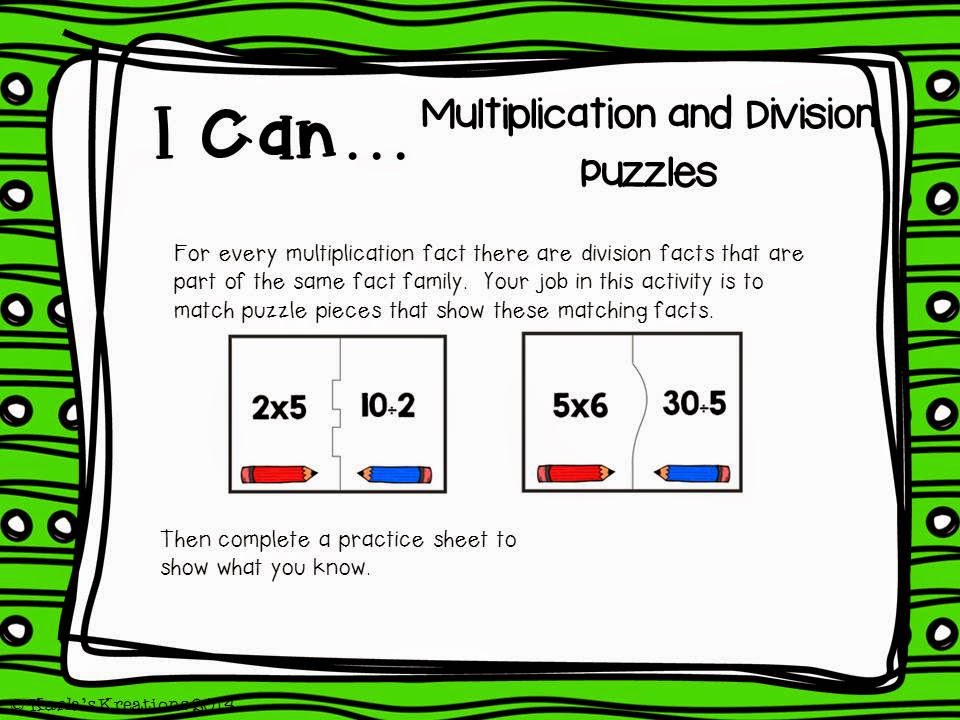
We have 14 days of school left and my brain has moved on to 3rd grade.  Probably not a good thing because there's a lot that still needs to be done this year...  However, I've been working on Math Station activities for 3rd grade.  Here's a sneak peek at some of the math stations in my new product. Fun stuff!  I love teaching multiplication and division!  You can check it out at my TpT store- Multiplication and Division Math Stations: August Edition  And, my whole store is on sale May 6-7 for the Teacher Appreciation Sale!


Tuesday, April 15, 2014

The Equal Sign in Kindergarten

I love how math topics just come up naturally in our classroom.  The other day we were doing one of our daily math pages as a warm up to our math time. It was this particular one from my April Morning Math and when we got to the Comparing section we came to 10=10.
There haven't been a lot of these comparing statements that have been equal, so it was a great time to talk about what the equal sign really means.  We talked about how it means the same as, how the answer usually comes after the equal sign, but sometimes not.  Then, a teachable moment arrived.  I gave them an equation: 2 + 3 = 1 + 4.  "Hmmm," I said to them, "What do we think about this?"  I had them turn to a partner and talk about it.  We've never done anything like this before, so there was no telling where we were going with this one.  Right away, when we began to share, one of my smarties said, "It's true.  Take the 4 apart and give 1 to the 1.  That makes 2.  Then you have 3 left out of the 4 and then it's 2+3 on the right side too. So that means it is the same."  Wow!  Someone else said that they could just get an answer from both sides- since 5 was the answer on both sides, it was true.  We tried a few more along the same lines and more of them began to get an idea of what to do.  I know that Kindergarten doesn't have a CCSS about the equal sign, but here's the 1st grade standards.
1.OA.D.7 Understand the meaning of the equal sign, and determine if equations involving addition and subtraction are true or false. For example, which of the following equations are true and which are false? 6 = 6, 7 = 8 – 1, 5 + 2 = 2 + 5, 4 + 1 = 5 + 2.
I guess I am a little ahead of the game, but when those moments come up, you just can't let them pass by. We did another one today and here's what we did.  I love that my smarties are beginning to compensate without me even teaching the strategy!!!  Of course, we had to name it and refer to it by name every time someone uses it in the near future.  Can't wait to see what they can do next- I think I will give them equations with one addend missing on one side like this:  3+4 = ? + 2.

Monday, April 14, 2014

Writing about a topic (No Pink Blueberries)

I love when Kinders begin writing more than one sentence!  There comes a point in the year when their writing really takes off and they will write three or more sentences independently about a topic.  But with that comes the random fact writing.  It really hit me hard a couple of weeks ago when we were writing about plants.  Here's what one student wrote- their topic was "fruit".  "Baby blueberries are pink.  Seeds are inside fruit.  Fruit grows from the flower.  We eat fruits like bananas."
All true- and all facts about fruit.  However, I cringe a little reading it because the facts are so disjointed. So, my question I pondered was- Can kinders write sentences that all flow together or am I asking too much?  I decided to test it out!  When I taught first grade we used a "flee" map to organize our topic- it's a Write from the Beginning thinking map.  Here's a basic sample of what a flee map might look like.

Most of my kinders are no where near ready for this but could I adapt a little to fit kinders?  I felt like a beginning sentence was a good place to start.  The beginning sentence set the topic and would keep the pink blueberry sentences from occurring.  So I made this.
Click on the link to get a copy.  Flee Map Kinder  The top box is designed for the beginning sentence and the big boxes below it are meant for pictures and key words.  My plan was to begin teaching this with everyone using the same beginning sentence and everyone deciding together on the 3 key ideas.  Then they would use this pre-writing organizer to write their own sentences about the topic.
We're learning about community workers so we tried it with a book about doctors.  We came up with a very basic beginning sentence.  Doctors help people.  Our details were about how doctors help healthy people, sick people and people in emergencies.  Here are some of their flee maps.


And here are some of their writing samples.
 Doctors help people.  Healthy people go to the doctor to stay healthy.  When people are sick they take medicine.  In emergencies doctors give them band-aids. (I love the speech bubble!)

Doctors help people. People get shots when they're healthy.  Doctors listen to your heart.  In emergencies and your bone is broken, you get a cast.

They have a long way to go and I am sure I will get many more "pink blueberry" sentences, but using the flee map to help them organize their ideas is a good beginning step.