Showing posts with label Flash Back to school sale. Show all posts

Monday, July 7, 2014

We Go Together: A Back to School Activity- Flash Sale July 7

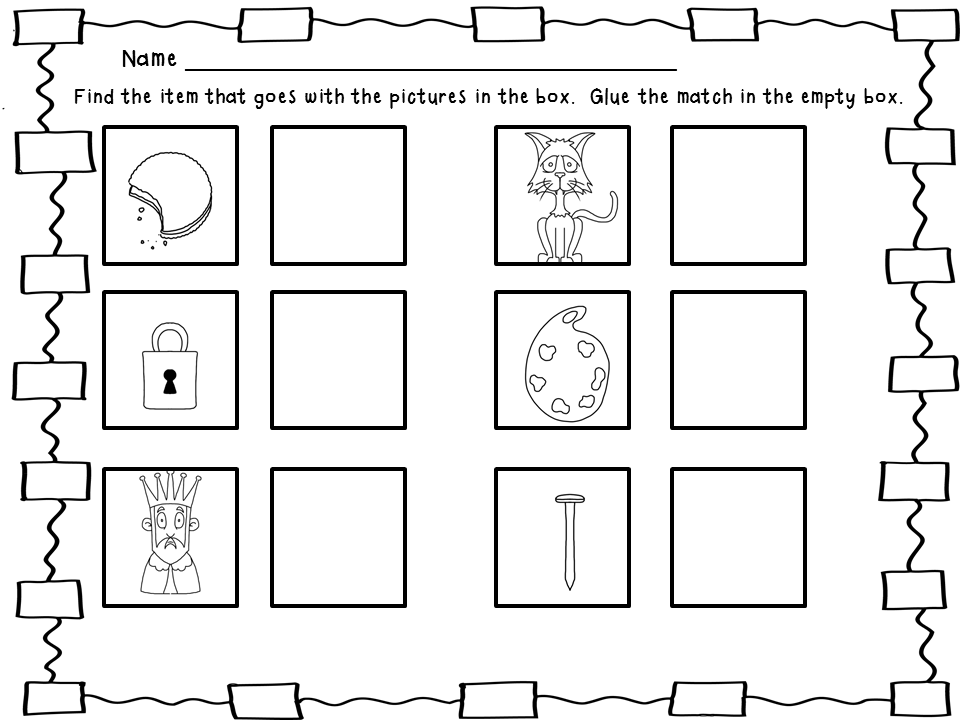
Today I would like to share with you a fun and easy back to school/ice breaker activity you can use the first week of school.We Go Together: A Back to School Matching Activity
Originally, it was designed for use in my Kindergarten classroom as a pocket chart station at the beginning of the year.  We do a lot of sorting the first month of so of Kindergarten and this is a variation of that.  They have yellow cards with pictures on them and they need to match it with a blue card that goes with each yellow card. It's a great activity because the students have to talk to each other about why the cards go together or don't go together.


I used it last year at the beginning of the year and the students really liked it.  Once they are finished, they can also do one of two worksheets.


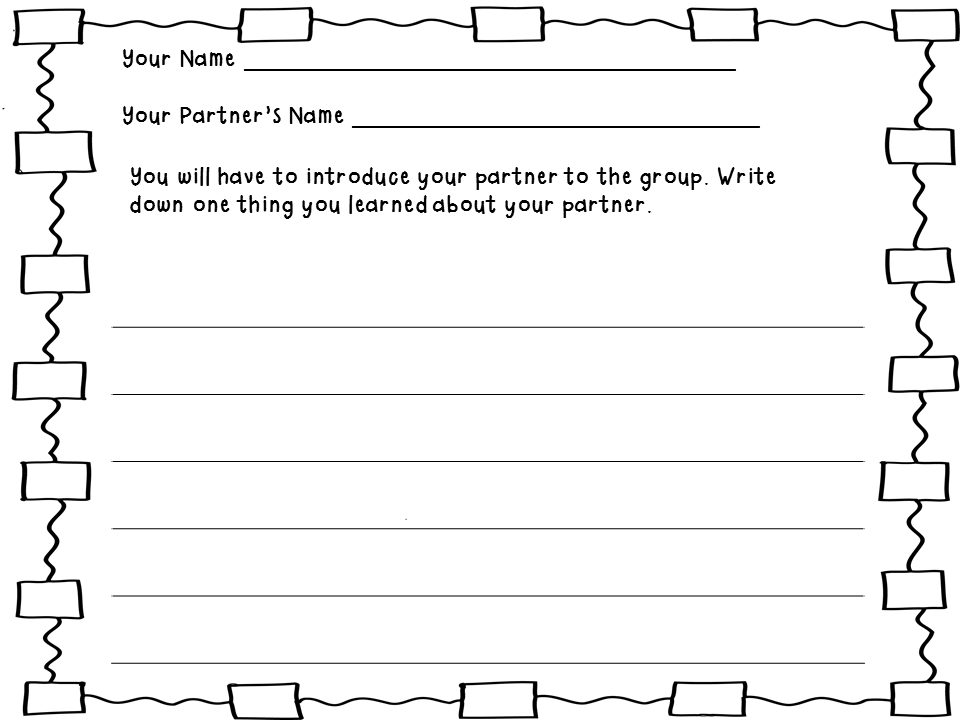
But, this year I plan to use it as an ice breaker/get to know you activity with my 3rd graders.  I plan to give student either a yellow or blue card.  They have to search around the room for their card's match: peanut butter with jelly, paint with paintbrush etc...  There are enough pairs for a class of 30 students. Once they find their partner, then they have to find out something about their partner using this form.
After that, they will introduce their partner to the class.  Quick, easy and fun for the first week of school.


Sunday, July 6, 2014

August Morning Math: Kinder and 3rd Grade Editions- Flash Sale July 6

Today's flash sale features TWO of my August products- both of them are daily math reviews.
Kindergarten August Daily Math
3rd Grade August Daily Math

(Please Note: Most of my Kindergarten products were sold under Kinder Karla; I recently changed my store name to reflect more diverse products)

In Kindergarten, these were used to start my day.  They were "bell work" for the students.  I have all months available for Kindergarten and they follow a logical progression of skills throughout the year. I really like them because each sheet has different skills to practice.  Here are some picture of the Kindergarten product. As you can see, student practice writing numbers, counting, drawing a set and making a pattern.  The first two weeks, the number they write matches what they count and what they draw.  The second two weeks, those are mixed up.

In 3rd grade, I plan to use these as a warm-up for my math block.  Or I might use them as homework.  We'll see how it goes.  I haven't created more than the first month for 3rd grade yet because I want to see how successful they are with this group of students.  Each week has Operations and Algebraic Thinking and Numbers in Base 10, and Measurement, Data and Geometry- alternating between time and money and beginning fractions and graphing.  All skills covered in August are 2nd grade standards meant to be a review of skills from the previous year.


Saturday, July 5, 2014

Back to School Counting Activities: Flash Sale July 5

Today I am offering my Back to School Counting Activities as my Flash Sale product.
It includes 5 different game and activities that are easy enough to play at the beginning of the year.   These were the first Math Station games that we did after we did the Exploration Stations.
 The first one is an easy matching game with number cards.  There are numbers, tally marks and ten frames.  You can play it lots of different ways.  Student can draw a card and count and identify it.  You can play concentration with two sets of the cards.  You can match the three cards on a pocket chart.

 The next game is an easy variation of Bang! where a student draws a card, counts the objects or reads the number.  If he is  correct (checked by the group) then the student keeps the card.
 This next game is a good one to begin to teach students how to use a recording sheet during a math station.  There are cards with sets of objects.  The student draws a card, counts the amount and writes the answer in the correct spot on the answer sheet.
 Quick-How Many? is really designed for small or whole group.  It's all about subitzing.  Show the different dot cards and students tell you quickly how many and what they see.  At first, it is not very quick because they will really just be counting, but hopefully over time, and with practice, students will begin to see combinations of objects.

 The last game has sets of cards in straight lines and scattered configurations.  A student takes  a card, counts how many and then he spins the spinner.  If he lands on 1 more, he adds one counter to the card and counts 1 more.  If he lands on 2 more, he adds two counters to the card and counts 2 more.  It is a great game to see how students are counting that one more- do they need to recount it all again, or do they remember what they had and count on to the next number in the sequence.


Friday, July 4, 2014

Flash Sale: July 4

Happy 4th of July everyone!  Today as part of my Flash Sales of Back to School products I would like to share with you my Read It, Trace It, Put the Sentence together packs.  I have them for almost everything imaginable, but today's feature is the Back to School pack.
 These came as an idea from one of my teammates a few years back when we were looking for an easy idea for a writing station.  I created between 5-10 sentences for each theme idea and then created these two different formats.  These were the first things I sold on TpT when I first started out!  There are two forms- one with traced lines and the other with blank lines.

When I am first starting out with these, we do them whole class.  In fact, I model them under the document camera.  I always begin using the traced version because it is much easier for the littles to do this at the beginning of the year.  I read the sentence to them.  We practice reading it together tracking the print across the page.  Then we read the sentence as it is written at the bottom.  The littles get a big kick out of the fact that it doesn't make sense at the bottom.  We talk about what a sentence starts with (a capital letter) and ends with (punctuation- usually a period).  We find those in the boxes at the bottom.  They cut out the boxes at the bottom (great fine motor practice) and then we begin matching the words and creating the sentence.  We talk about going left to right across the page and putting small spaces between words (just like we do in writing).

Once they are finished with the sentence, we read it one more time and match it up with the sentence above to make sure we are correct.

Then, in the space at the bottom we draw a picture.  I model drawing the picture- reading the sentence and thinking about what I could put in my picture.  We talk about using the whole space; we talk about correct color (your teacher is NOT purple); we talk about adding details; we talk about how we don't want people to float in space- all those little drawing things you want to transfer over to their other drawings- but things that take A LOT of reinforcement!

Once we do many of these whole group, then the Read It, Trace Its become part of my THEME station.  My theme station is basically a Science/Social Studies station and other versions of these (apples, community workers, bats, American symbols- the list goes on and on) become one of the choices of what students do at that station.  Eventually, we transition to the blank lines (and I have to model that piece multiple times when we do).

The littles never get tired of these because the sentences are always changing.  You can differentiate it a bit if they finish the sentence early, they can write and illustrate an additional sentence on the back that tells more about the first sentence.


Thursday, July 3, 2014

Flash Sale July 3

To continue my July flash sales of all my August products, I move on to my Daily Word Problem series.  Today ONLY my August Word Problems are 1/2 off!
I began creating these monthly word problems packs last year as a request from my teammates.  I have always done a lot of word problems in my classroom and it was a perfect way to share with them what and how I do it.  So, I began in December with these packs and each month created one with themed word problems.

But when I went back to think about August word problems I knew that the format would have to be a little bit different because our kiddos are so brand new to problem solving (and everything else for that matter) in August.  The word problem is written at the top with space for students to draw a picture.  I don't know about you, but my kinder babies have always fallen into two categories- those that love to draw and are good at it and take a really long time and those that could care less about it.  This was a problem in math because if the word problem said "I have three pencils." some students took FOREVER drawing detailed pencils and others were finished in two seconds with their pencils.  So, we talked about it as a class.  I explained to them that their detailed drawings of the word problem wasn't the important part.  We talked about drawing during our writing time and how it is different than drawing in math time.  And, we decided as a  class, that we were NOT going to draw the objects with lots of details in our math word problems.  We decided that it was enough to represent our objects with circles or squares or lines and that the important part of it was our MATH not our drawings.  This made problem solving a lot easier because it took less time when they weren't worried about what their pencil looked like.

So, the big part of each problem solving page is the space for the picture.  Students generally begin as direct modelers of word problems so whether they use manipulatives and then draw a picture to show what they did with the manipulatives or just draw  a picture there's plenty of room for them to work.

The bottom section is the big difference between later word problems and August and September word problems.  In  later months, I have an empty number line, a space for the equation, and a empty number bond.  But, that was just too much for August.  The bottom section is totally optional for the student and it can become a teaching moment when students are sharing.  It's also great for those early finishers because you can ask them to show how they solved it using one of those other tools at the bottom.

I decided to put a ten frame at the bottom and hands.  The ten frame is just a great tool for them to see all the time and it's easy for the student to represent the two sets with different colors on the ten frame.  I put the hands there because my team noticed last year that this particular group of students had NO IDEA how to use their fingers to do math.  It's the first time we've ever noticed it because it seems like students just come in instinctively knowing that their fingers can help them count- not this last group!  I literally had to teach them how to use their fingers to help them add! So, that's why the hands are there in August because, in case they don't know how to use their fingers, we can practice it from day one.  [Not that I really WANT them using their fingers as their only tool- but it was just so bizarre that NO ONE even had the thought that they could use their fingers]

Another big part of this word problem packet are the journal page strips.  I actually use these more than the whole sheets because I have students doing most of their problem solving in a composition notebook.

Each word problem is also on one sheet in these strips- copy the page, cut apart the strips and students glue them into a page of composition notebook.  Then students solve the problem however they choose.  Same idea, just a little less paper to use!  And then you can use the whole sheets when you want to take a grade or get an idea of how students are progressing on a particular problem type.

A little note about problem types:
The word problems this month are all basic problem types- Add to Results Unknown, Take From Results Unknown and Part Whole Whole Unknown with just a few Put Together Addend Knowns thrown in there for fun!

Happy Problem Solving!

Karla


Wednesday, July 2, 2014

Flash Sale: July 2

With school about a month away for me, I've decided to promote one Back to School product each day (until I run out of Back to School/August products). Today is my August Math Stations for Kindergarten.  It has 5 different structured stations perfect for the beginning of the year.


In addition to the five structure stations, I also created some Exploration Station Task Cards.  Exploration Stations are a life-saver for me in Kindergarten the first month because I start off with them during math stations.  At first, they are just free play with the manipulatives- getting the students used to working together, working with math tools, and staying focused for more than 3 minutes at a time.  Then, I begin to focus the activities a little more.  This is where these cards come in.  I made 3 different kinds- patterns, counting, and sorting.  And I made them for three different kinds of manipulatives- bears, linking cubes, and colored counters.


And, today ONLY this product is on sale for 1/2 off!    Here's the link to my August Math Stations

Check them out, and be sure to stop by tomorrow for another August product!