Sunday, January 11, 2015

Biography Interactive Notebook

I've had a busy weekend.  Over Winter Break I started this interactive notebook, but didn't have time to finish it.  So, this weekend I spent a lot of time coloring, cutting things out, and making sample notebook pages to finish up this notebook.  One of our social studies standards in Arizona for 3rd grade is "Recognize that individuals worked for and supported the rights and freedoms of others (Susan B. Anthony, Jackie Robinson, Rosa Parks, MLK, Cesar Chavez)"
I chose to NOT focus on Martin Luther King, Jr. because it seems that every grade K-2 does something for him and my students know about him already.  Instead, I figured I would concentrate on the rest of the people that they might not have heard of already.  Click on the link here to find this in my store.

You need specific books for this notebook-
A Picture Book of Cesar Chavez by David Adler
A Picture Book of Rosa Parks by David Adler
A Picture Book of Jackie Robinson by David Adler
Susan B. Anthony by Lucille Davis
There are vocabulary words for each book and three different notebook activities for vocabulary.
Then each book has at least two different activities.  The pictures below show the activities for the Cesar Chavez book.


The picture below shows the activities for the Rosa Parks book.

The picture below shows the activities for the Susan B. Anthony book.

The picture below shows the activities for the Jackie Robinson book.

There is also a culminating activity that lists four events- one per person- and ask students to write about how the events are connected.  

 One of my favorite activities is a life quote circle map that I made for each person. I chose a quote from each person and wrote it in the middle of a circle map.  My plan is that the students will write events from the person's life that represent that quote.  For example, Cesar Chavez's quote is the UFW's slogan "Si se puede" which means "Yes, we can."  I want the students to think about Chavez's life and write down things that happened to him that represent his belief of not giving up on making things right for the migrant farm workers.  Then I want students to write a paragraph explaining how that quote defines Chavez's life.  Here's are my samples to give you can idea.


Saturday, January 10, 2015

Figurative Language Interactive Notebook

Ok- I am loving interactive notebooks just a little bit right now.  In fact, I think I am going a little bit overboard... but, they are fun and it's a good way to practice skills or reinforce a lesson.  I know I am not doing it correctly according to the interactive notebook gurus, but it's working for me right now.  With that being said, I created a new interactive notebook for figurative language, specifically idioms, homonyms, similes and personification.  Here are some pictures that show my samples. (I used the colored versions of the clip art to save me time coloring it all- the students are blackline pictures they can color.) It's in my TpT store at this the link here.  Hope it's something that might be useful to someone.


 These are flaps with an idiom on the front cover.  Under the flap, students write what the phrase means.
 This is a cute flap book.  The front gives the meaning and students have to match it to an idiom.  For example, one says "If something is really expensive, you say..." and the picture and words that match say, "it cost an arm and a leg."


 These pictures show the activity for homonyms.  There are ten words that have multiple meanings.  Students have to write a phrase to explain that particular picture.  Then they glue it on as a flap.


 This picture shows an accordion book of similes.  All students do with this one is glue, color,  and put the book together. The last page has a space where they can write what they know about similes.

 These pictures show an activity for personification.  Students read the phrases and under the flap they write what the phrase means or when it would be used.  For example, the one that says "His feet are tired" underneath the students might write that it was a long day and the person maybe had to walk or stand for a long time.

Thursday, January 1, 2015

Quotation Marks and Commas

Happy New Year!  It's a frigid 37 degrees here in Phoenix, Arizona at 1 pm.  For those of you who live where it really gets cold, don't judge- we desert rats are freezing!!!!!!

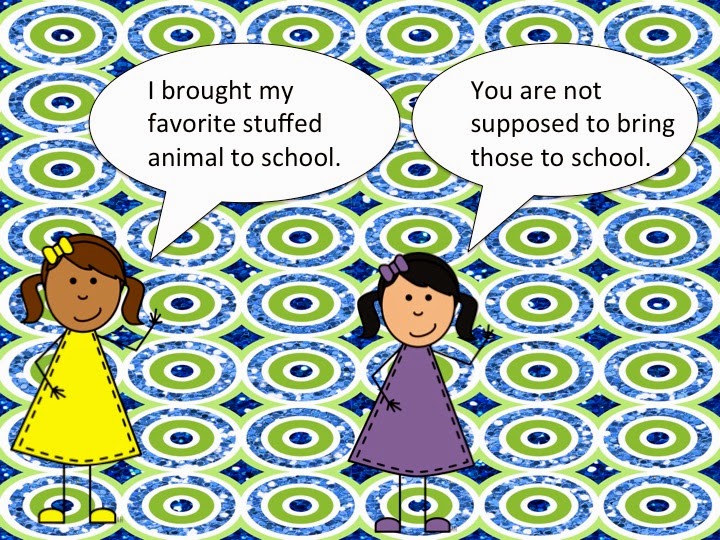
Since it's too cold to go outside (LOL), here's a quick and fun activity I made that I plan to do with my 3rd graders when we come back.  It focuses on L.3.2.c.  Commas and Quotation Marks in dialogue.

It's a series of speech bubble dialogues.  The students have to write the conversation as dialogue using commas and quotation marks correctly.


 There's a couple of blank ones where you have students write their own dialogue.  And, there's an interactive notebook page that you can use as a formative assessment.

Tuesday, December 30, 2014

Civil War Informational Text

One of our Arizona standards for Social Studies for third grade is "Discuss contributions of people during the Civil War (Abraham Lincoln, Ulyssess S. Grant, Harriet Tubman, Sojourner Truth, Frederick Douglass)".  As I've said in previous posts, our social studies book is all about Communities.  So, in order to teach this standard, I either need to create something, buy something, or just ignore the standard completely since it's just social studies.  I can't find any informational text on TpT about these specific people written at a level my 3rd graders can understand, so I decided to write it myself. I chose everyone on the list except Lincoln, and I included Robert E. Lee as well because I thought he was interesting.  I figured there were enough books written about Lincoln that I can use those, and we talk about him every year for President's Day.  Here are some pictures.


You can get the freebie here.  It goes nicely with the Civil War Interactive Notebook that's also a freebie on TpT.

Friday, December 26, 2014

Chris Van Allsburg Interactive Notebook

     I have loved Chris Van Allsburg books my whole teaching career.  I love his style of illustrations; I love the stories; I love the little twist or magical elements that always appear in the books.  Heck, I even love searching for Fritz in all the books.
     So, when I moved from Kindergarten to 3rd grade I this year I was so excited to finally be able to read his books again with my students- (Kindergarteners totally miss the finer points of his stories LOL).
     And, when I decided to venture into the world of interactive notebooks with mentor text read alouds, he's the first author that came to mind.  You can get it in my TpT store here.
  
     When I get started on a project, I work for hours and hours on it practically non-stop.  Amid all the holiday stuff this week, that's what I've been doing!  I chose four of his books to focus on at first- The Wretched Stone, The Sweetest Fig, The Wreck of the Zephyr and The Garden of Abdul Gasazi. I chose vocabulary from each book and created a vocabulary activity that is the same for each book (just a different way of representing it in the notebook).  Then I created at least two different activities that can be done for each book.  Most of the activities focus on character development or how the characters' actions contribute to the sequence of the events.  Here are some pictures of final products.


I am very excited to try this out with my 3rd graders when we return!  Coming soon: Patricia Polacco and Eve Bunting!

Wednesday, December 24, 2014

Civil War Interactive Notebook

     I missed out on the beginnings of the interactive notebook craze.  But, it's not too late to jump on the bandwagon is it?  I am a little nervous about my first interactive notebook activity.  It's about the Civil War.  We teach it in 3rd grade in Arizona, but really only have two standards to teach. Recognize that there were issues associated with the Civil War (slavery, states' rights, South seceded from the Union) and Discuss contributions of people during the Civil War (Abraham Lincoln, Ulysses S. Grant, Harriet Tubman, Sojourner Truth, Frederick Douglass).  Pretty basic, right?
     Except that our social studies textbook is all about Communities and has NOTHING about the Civil War... so, once again, I am forced to create something in order to teach what I am required to teach. (See previous post LOL- no soapbox today).  
     So, I decided to jump on the Interactive Notebook bandwagon and try my hand at creating activities that I can use to reinforce things I will teach.  It's my first try at it, so be nice.  It's a freebie on TpT Civil War Mini-Interactive Notebook.  It has 5 different activities.  The first one focuses on characteristics of the North and South prior to the Civil War.  The second one lists 5 main "issues" that were key to the conflicts.  The third activity is a map of what the U.S. looked like prior to the Civil War.  The 4th activity is a cause and effect about secession.  And the last activity focuses on important people.  I think I hit both standards with these five activities. YAH! Here are some pictures of what the final product looks like. ( I apologize for the one sideways picture...)
     Look for more interactive notebook stuff coming soon- they are FUN to create!  I think I'm hooked.  


Tuesday, December 23, 2014

End of Quarter 2 Reflections and Ramblings

     Although I am convinced that no one reads my blog no matter how I try to promote it, I will continue to post.  I suppose it is my fault because I am not consistent with posting, I don't promote myself well on Pinterest and I just feel like I don't have anything exciting to say.  Or, maybe I just can't toot my own horn well enough... I don't know, but it's frustrating at times.  That's probably part of the problem, because I make these sarcastic, negative comments.  Instead, I need to be bubbly, enthusiastic and super-excited all the time about the fabulous learning that is happening in my classroom.
     Don't get me wrong- fabulous learning is happening in my classroom.  But, sometimes it's not that exciting! And, I am not sure it's always best practices.  And, I can't stop making sarcastic, negative comments... so, don't continue if you expect a bubbly, cutesy and everything is fabulous post. :)
     I've taught for 21 years, and I can honestly say that we are at a strange time in education.  I think the last time things were this strange was when we started No Child Left Behind... Hmmm, that's interesting- whenever we have programs/standards shoved down our throats without any training teaching becomes so much harder.  But, the shift to No Child Left Behind felt different that this one.  At least with NCLB, the district I was in was purchasing programs and putting money into the new hoops we had to jump through.  Now, in the district I am in (a different, more affluent area than I was in for NCLB) we are alone-sinking or swimming and not knowing how far the shoreline is, what dangers are lurking out there, and where we can go for help.  My district has provided next-to-nothing for us in terms of resources to help us shift into Common Core.  We have had maybe 4 hour total in training (shifts in common core standards and close reading).  Our district purchased the Eureka Math books for the teachers and told us it is not a required curriculum.  No resources have been provided for language arts. And, there's no plan to purchase resources.
     Teachers are left with nothing to use to teach the new standards.  Thank goodness for Teachers Pay Teachers...  But, with teachers buying their own things comes problems we're not thinking about. 1) Teachers are getting poorer if that's even possible! 2)  Teachers are getting resentful that they are need to provide curriculum for the district (My husband always says, "Shouldn't your district be providing that for you?" when he sees the credit card bills.) 3)  There's NO consistency from school to school, district to district.  I think that last one is the biggest one- and the one that will hurt us the most in the long run.  The standards are vague enough that there's all kinds of interpretations about what they mean, how they will be assessed and what students should be able to do after that standard has been taught.  The Common Core standards are supposed to unite us so we're all teaching the same standards... but I think because of districts' lack of support to teachers it is really going to backfire on us at some point.
     So, here I sit reflecting on my Quarter 2 and I can honestly say that good teaching wasn't always happening every day at every moment. (I think after reading way too many blogs that I am the only one this is happening to- or I am the only one telling the truth)  I am limited by time, resources and support.  In past years we had resources, so I had more time to supplement those resources and create better lessons.  Now, I have no resources so the time I have is spent just interpreting the standards and then finding what I need to teach.  Those things aren't perfect so I either spend time I don't have making them better or use them even though they are not always "best practices".  It's a vicious cycle that I honestly don't see an end to.  I see teachers more frustrated than we've ever been before.  I see veteran teachers saying that they don't know how to teach anymore. I see newbies wanting to quit after one or two years because it's not worth the hassle.  I see administrators putting more and more pressure on us and asking us to do more and more with less and less. I see tests that don't match the standards but we're being judged on our test scores.
     Okay, now I somehow have to bring this around to a positive and leave this post feeling motivated, excited and ready to move forward to a new year with bright possibilities and a myriad of wonderful learning experiences.  That's what I'd like to do...but not sure that I can.
      Even though standards have changed and sometimes it seems like the children we are teaching are changing, good teaching doesn't have to change.  Students need us to know how they learn best.  Students need us to know that we care.  Students need us to know that they are more to us than a percentage on a high-stakes test.  When we look out at our students, we need to see beyond the latest federal programs, the lack of resources and all the other problems facing our education system today. We need to see past that to the 25 (or more) individual students that don't care which standards we are teaching or which program we are using or which test we are taking in April.  They just want a teacher who knows what they are doing, who cares about them, and has their best interests at heart.