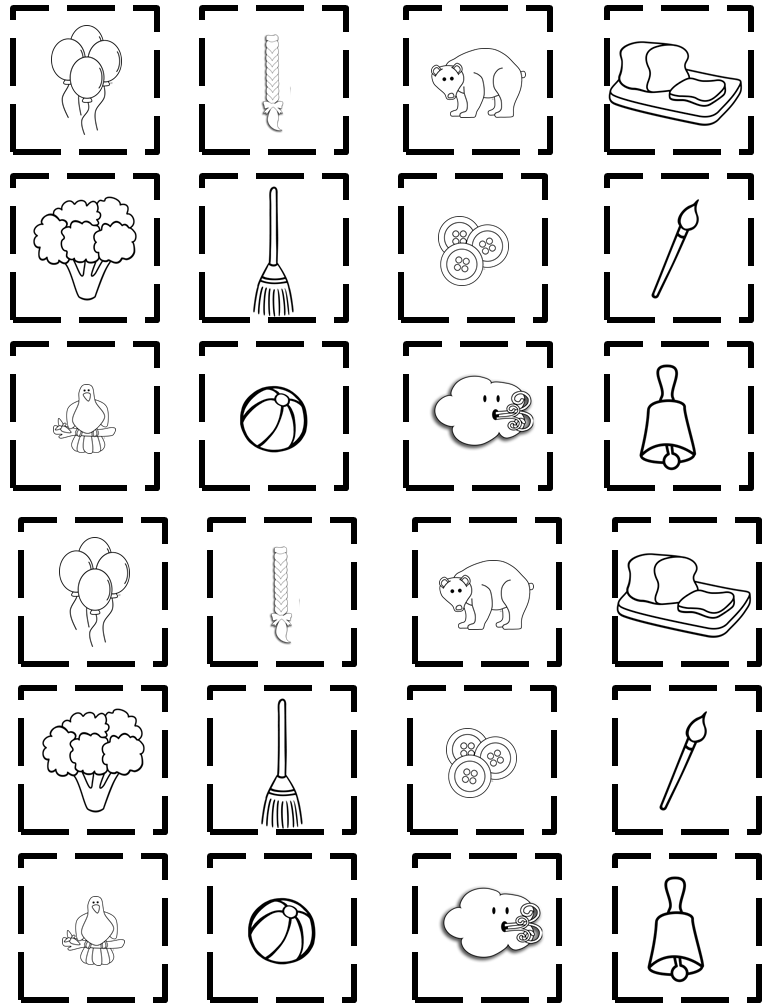
No, we don't do standardized testing in Kindergarten. The closest thing we have is DIBELS. And, this year I have had so many students that I've had to progress monitor. It's because we're using the new updated benchmark scores which are crazy hard to reach for many of my students. So, in order to help them practice, I decided to create some "task cards" for me to use with them during guided reading groups. I print them with the phoneme segmentation pictures on one side and the nonsense words on the other side. I go around my group and I say the words on the cards. Students stretch out the sounds just like on the phoneme segmentation test. Then we flip the cards over and read the words on the back. Sometimes they read just one or two columns and sometimes I time them to see who can read the quickest with the fewest errors. They have a lot of fun with the cards, and it's pretty quick. Some days we only do one side if we're in a rush to get more reading done. Here are some pictures. Find it at my store- Nonsense Word and Phoneme Segmentation Task Cards. It's discounted through the weekend- along with everything else in the store.
Friday, March 28, 2014
Tuesday, March 18, 2014
Close Reading with Leo Lionni
My principal is coming next week to do our next observation. She doesn't tell us when she's coming exactly, but has given me a time frame during our whole group reading time. Since we've been so focused on close reading this year, I decided that I want her to see what we've been doing in kindergarten for close reading. All the trainings we've had really focus more on the upper grades and how to do close reading with them. I've yet to see a real example of close reading in Kindergarten. So, with that being said, I don't really know what I am doing. I can only try to adapt what little I really know about close reading and approximate those strategies with Kindergarteners.
I love doing author studies. My latest is Leo Lionni. Love his books, and love the conversations I've had in the past with higher grades about his books. So, we'll try some Leo Lionni close reading and see what happens. I created this freebie for anyone who might be interested for three of Lionni's books- Frederick, Fish is Fish, and The Busy Year. Close Reading With Leo Lionni
For each book, it's a three day sequence- I know some people are doing five days, but I just can't stand to read the same book for 5 days! I think that's overkill a bit. The first day usually focuses on reading the book for enjoyment and basic understanding of the plot. We also focus on vocabulary that first day. I created this sheet to record two words from the story.
The second day is usually focused on text-dependent questions. What do we know? These are the literal questions with an answer that's right there- the thin questions. What do we think we know? These are inference/generalization questions-the thick questions that have answers partly there but you have to dig a little deeper to prove why you think that. Here are some samples of those types of questions for Frederick.
The third day either is either specifically inference questions, like with Frederick, or something specific to the book. For example, in The Busy Year, day three is all about sequencing. In Fish is Fish, day three focuses on specific adverbs the author uses to describe how the characters speak- mysteriously, triumphantly, excitedly. Of course, this is done without really telling the students that these words are adverbs... Students practice intonation and make connections to their lives- when would they speak triumphantly or excitedly etc...
There are opportunities for writing about the text, but it's not really necessary- I think the conversations themselves are almost enough for them.
I will let you all know how it goes, and if you download the freebie and try it, let me know if it was successful.
I love doing author studies. My latest is Leo Lionni. Love his books, and love the conversations I've had in the past with higher grades about his books. So, we'll try some Leo Lionni close reading and see what happens. I created this freebie for anyone who might be interested for three of Lionni's books- Frederick, Fish is Fish, and The Busy Year. Close Reading With Leo Lionni
For each book, it's a three day sequence- I know some people are doing five days, but I just can't stand to read the same book for 5 days! I think that's overkill a bit. The first day usually focuses on reading the book for enjoyment and basic understanding of the plot. We also focus on vocabulary that first day. I created this sheet to record two words from the story.
The second day is usually focused on text-dependent questions. What do we know? These are the literal questions with an answer that's right there- the thin questions. What do we think we know? These are inference/generalization questions-the thick questions that have answers partly there but you have to dig a little deeper to prove why you think that. Here are some samples of those types of questions for Frederick.
The third day either is either specifically inference questions, like with Frederick, or something specific to the book. For example, in The Busy Year, day three is all about sequencing. In Fish is Fish, day three focuses on specific adverbs the author uses to describe how the characters speak- mysteriously, triumphantly, excitedly. Of course, this is done without really telling the students that these words are adverbs... Students practice intonation and make connections to their lives- when would they speak triumphantly or excitedly etc...
There are opportunities for writing about the text, but it's not really necessary- I think the conversations themselves are almost enough for them.
I will let you all know how it goes, and if you download the freebie and try it, let me know if it was successful.
Sunday, March 2, 2014
Opinion Writing Follow-Up
A couple weeks ago I posted about opinion writing. I had several topics I was going to try with the students during our mini-unit on opinion writing. Click here to go back to that post. Well, I always wonder when people share things that they've made if it always works exactly the way they envision. Because, at least for me, even my best laid plans need to be adjusted a little bit to accommodate my particular little ones that year. So, I thought I would revisit this idea and share some insight into what worked and what didn't work.
I began with opinions about food. I thought my littles would be able to explain why they liked pizza or ice cream. Wow, was I wrong. It was a very rough couple of days starting our opinion writing! They didn't have the vocabulary to describe the foods they liked. They were all "good" or "yummy". It was very difficult getting them to think about really why that pizza was so good- what did they like about it. And, there were too many choices to really concentrate as a class on specific describing words- favorite food, favorite cookie, favorite ice cream- left too many choices to effectively do class mini-lessons that the whole group could benefit from. So, next year, I will definitely not begin with favorite foods.
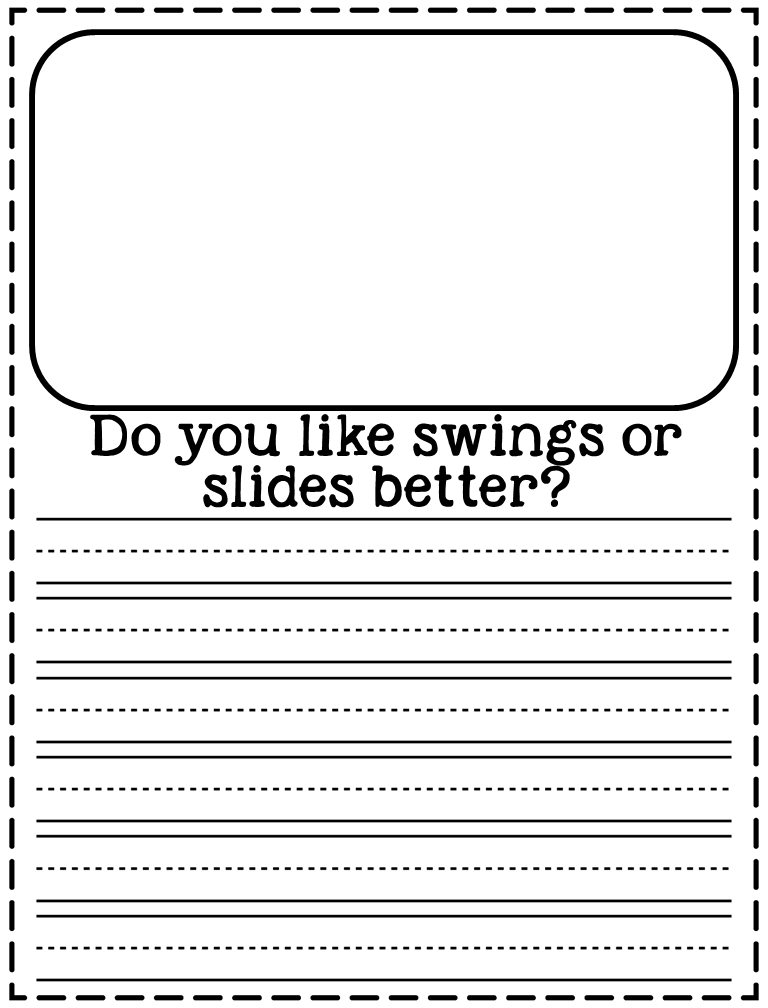
I almost gave up and decided to do some different type of writing, but I kept going and decided to try having the students write about the playground. With these, I gave 2 choices and asked them which one they liked better. That was much easier for them. I started with this one.
I began with opinions about food. I thought my littles would be able to explain why they liked pizza or ice cream. Wow, was I wrong. It was a very rough couple of days starting our opinion writing! They didn't have the vocabulary to describe the foods they liked. They were all "good" or "yummy". It was very difficult getting them to think about really why that pizza was so good- what did they like about it. And, there were too many choices to really concentrate as a class on specific describing words- favorite food, favorite cookie, favorite ice cream- left too many choices to effectively do class mini-lessons that the whole group could benefit from. So, next year, I will definitely not begin with favorite foods.
I almost gave up and decided to do some different type of writing, but I kept going and decided to try having the students write about the playground. With these, I gave 2 choices and asked them which one they liked better. That was much easier for them. I started with this one.
It was so much easier because we could talk about specific reasons why students liked spiral slides or straight slides. Then the students just had to choose their reasons. After we did this one, I kept the slide theme going with this one.
My whole range of writers could be successful with these prompts at varying degrees like this little above who needed me to support her by writing the lines for each word she wanted to say in her second sentence. Then we went on to another playground topic.
After that we began our Dr. Seuss opinion writing. We're not finished with it yet, but we did write about Cat in the Hat and Green Eggs and Ham. I was pleasantly surprised that they were able to do this successfully after we talked about the story whole group. They came up with some really good reasons supporting why the cat was "good" or why the cat was "bad". Here are some samples. I think it's funny that one said he was bad because he made the mess and the other said he was good because he cleaned up the mess.
Here are some Green Eggs and Ham writing samples.
I love this last one- "they are disgusting because I do not like green."
After completing my opinion writing unit, I have to go back to the proficiency scale that my team and I created.
I wanted them to give an opinion and support it with a detail. I think that most students were able to do this successfully. No one was just stating the topic- they all gave opinions and/or details to support.
For next year, I won't begin with food- I will definitely begin with playground topics before moving to more difficult topics like food. To get the freebie again- here it is: Kindergarten Opinion Writing
Happy Writing!
Monday, February 17, 2014
Blends
We are in the midst of teaching our little ones about beginning blends. This week we focus on R blends. Our district purchased curriculum has nothing for blends. Honestly, I cannot remember the last time I used a piece of district adopted curriculum. So it is up to us to create activities to practice blends. Along the line of Words Their Way sorts, I created these sorts for students to do to practice. I also made sorts for the Smart Board using Smart Notebook software and a page called the Vortex- pictures of all this in action tomorrow.
Click here to get this freebie that includes six r blends. My team and I are looking forward to use these activities to help our students differentiate between the single consonant sound and the consonant blend.
Sunday, February 16, 2014
American Symbols
We just finished a little unit on American Symbols. The idea of a symbol is a very difficult concept for kinders to understand. And, it is equally difficult for them to understand big words like freedom, strength, justice etc... But we used these Welcome Book that are part of our Common Core book tubs. They didn't totally understand the concepts, but it's a beginning. American Symbols are taught in 1st grade as well, so we did a good job of providing a beginning knowledge base on which 1st grade can expand.
These books are pretty good about giving very basic information about the American Symbols. Then I also used my Read It, Trace It, Put the Sentence Together packet for American symbols. These were at my Theme Station during our Literacy Stations. Get a part of it free here.
Then to tie it into informational writing I created these pages that we did after we read each book and talked about each symbol. We would create circle maps or tree maps together after reading the books. Then the students would write about the symbols. Get the freebie here.
Included is the Liberty Bell, the Bald Eagle, the Statue of Liberty, the flag, and the White House. I used our informational writing proficiency scale to grade their writing. And, then, of course, we did a craft activity for each of the symbols. It's a fun little unit to do right before President's Day.
![]() |
| http://www.amazon.com/The-Bald-Eagle-Welcome-Books/dp/0516278746/ref=sr_1_2?ie=UTF8&qid=1392510825&sr=8-2&keywords=american+symbols |
These books are pretty good about giving very basic information about the American Symbols. Then I also used my Read It, Trace It, Put the Sentence Together packet for American symbols. These were at my Theme Station during our Literacy Stations. Get a part of it free here.
Then to tie it into informational writing I created these pages that we did after we read each book and talked about each symbol. We would create circle maps or tree maps together after reading the books. Then the students would write about the symbols. Get the freebie here.
Included is the Liberty Bell, the Bald Eagle, the Statue of Liberty, the flag, and the White House. I used our informational writing proficiency scale to grade their writing. And, then, of course, we did a craft activity for each of the symbols. It's a fun little unit to do right before President's Day.
Saturday, February 15, 2014
Opinion Writing in Kindergarten
Kindergarteners love to tell what they think about things and they have opinions about everything! The tricky part is harnessing those opinions and writing them down to satisfy the common core standard W1. We've been using proficiency scales in our classroom a lot this year and my team created a proficiency scale for Opinion Writing.
So, we have this to work from when we revisit opinion writing. But, it's such a broad type of writing and I wanted to start with small topics that I can use when I teach the proficiency scale to the students. So I created this packet of easy to use opinion journal pages. The first week I will use the easier ones about favorite foods and fun things.
The second week it will be when we read Dr. Seuss books and we will do some opinion writing that connect to some of the books we're going to read.
After that, we'll see where the unit takes us. But this will hopefully be a good start for us. To get this freebie that includes ALL these samples and more, click here. Would love to hear your OPINION about the best way to teach this type of writing with our little ones.
So, we have this to work from when we revisit opinion writing. But, it's such a broad type of writing and I wanted to start with small topics that I can use when I teach the proficiency scale to the students. So I created this packet of easy to use opinion journal pages. The first week I will use the easier ones about favorite foods and fun things.
The second week it will be when we read Dr. Seuss books and we will do some opinion writing that connect to some of the books we're going to read.
After that, we'll see where the unit takes us. But this will hopefully be a good start for us. To get this freebie that includes ALL these samples and more, click here. Would love to hear your OPINION about the best way to teach this type of writing with our little ones.
Saturday, December 28, 2013
New Year Put Together Sentences
Here's another freebie from my store that I just posted. These sentences are great for morning work or a writing station. Students read the sentence, write (or trace) it and then cut apart the words at the bottom and rearrange them in the correct order. Finally, they draw a picture to illustrate it. It comes with both the tracing version and the blank line version.
Subscribe to:
Comments (Atom)